






Establishment of Research farm for Plantation of Exotic fruits
General Information:
The Across the globe, numerous fruit crops are cultivated, yet in Gujarat, India, only a limited variety is grown due to specific climatic conditions and agro- climatic zones. However, with the advent of climate change, new opportunities are emerging to cultivate exotic fruit crops in Gujarat, particularly in the North Gujarat region. This region, blessed with suitable land and water availability, holds significant potential for sustainable farming by introducing and promoting exotic fruit crops.
To address this potential, the Kantaben Kashiram Institute of Agricultural Sciences and Research has established an Exotic Research Farm. This farm serves as a platform for practical experimentation, enabling researchers to identify challenges associated with cultivating exotic crops in the region. The insights gained are then used to educate students and farmers in North Gujarat.
This model farm acts as demonstration hub, providing hands-on learning experiences for students and farmers alike. By observing real-time farming practices, students develop the knowledge and skills to implement integrated farming techniques on their own farms, promoting sustainable agriculture and fostering a new era of farming innovation in the region.
Objectives:
- Learning objective
- To demonstrate scientific methods of exotic fruit cultivation to students.
- To integrate theoretical knowledge with practical aspects, including syllabus content, government policies, and modern farming techniques, fostering skills such as project management and teamwork.
- To create a model demonstration project for students and educational resource.
- Research objective
- To introduce new exotic crop variety in north Gujarat region.
- To experiment different cultivation methods for sustainable farming of exotic fruit verities.
- To analyze soil biology and nutrient dynamics in exotic fruit crop systems.
- To study the economic feasibility and profitability of cultivating exotic fruit crops in the region.
- To demonstrate and train the farmer for exotic fruit cultivation as diversified Agri- business opportunities.
Exotic Crops & fruit bearing:
| No. | Crop | Date of Plantations | Fruit Bearing after plantation |
|---|---|---|---|
| 1 | Mull berry | 22/10/2024 | 2 years |
| 2 | Phalsa | 26/11/2024 | 2 years |
| 3 | Dragon fruit | 22/10/2024 | 2 years |
| 4 | Fig | 22/10/2024 | 3 years |
| 5 | Pomegranate | 22/10/2024 | 3 years |
| 6 | Avacado | 22/10/2024 | 3 years |
| 7 | Star fruit | 22/10/2024 | 5 years |
| 8 | Plum | 22/10/2024 | 5 years |
| 9 | Litchi | 22/10/2024 | 5 years |
| 10 | Blue berry | 25/10/2024 | 1 years |
| 11 | Guava | 10/02/2025 | 3 years |
Operations (The cultural operations carried out):
| No. | Operations | Date |
|---|---|---|
| 1 | Land preparation, Land levelled | 14/10/2024 |
| 2 | Soil sample collected | 17/10/2024 |
| 3 | Sowing operations a. Layout b. Digging c. Fertilizer d. Plantation |
17/10/2024 18/10/2024 21/10/2024 22/10/2024 |
| 4 | Insecticide application | 23/10/2024 |
| 5 | Sulphur powder application | 23/10/2024 |
| 6 | Irrigation | 10 Days Interval |
| 7 | Insecticide application | 10-22/11/2024 |
| 8 | Growth application spray | 15 Days Interval |
| 9 | Plant ring cleaning | 30 days Internal |
| 10 | Plot cleaning | 24/02/2025 |
| 11 | Fertilizer application | 45 Days Interval |
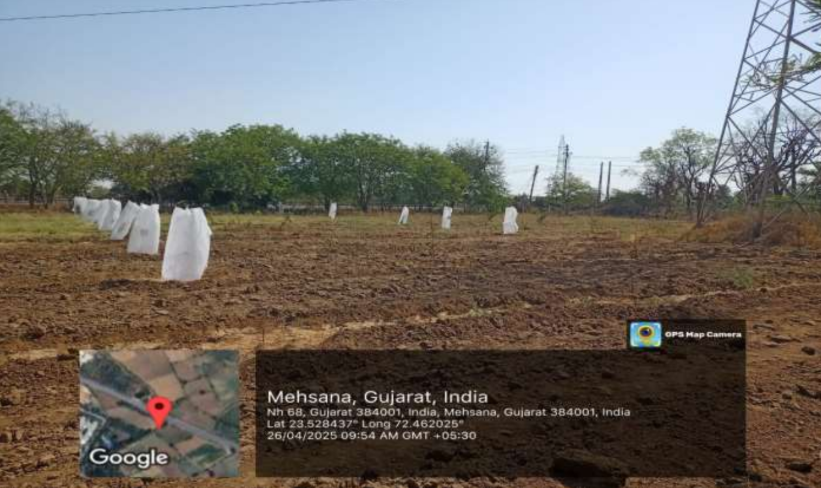
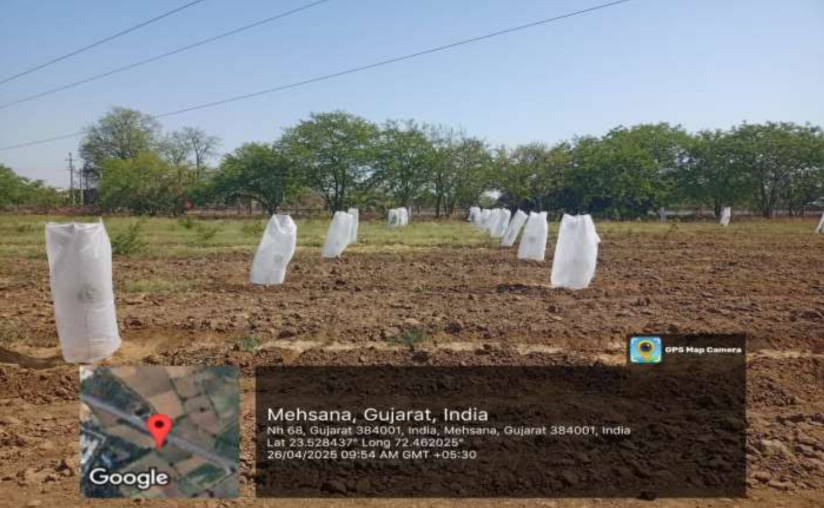
| 12 | Crop cover (heat Protection) | 25/03/2025 |
| 13 | Plot cleaning | 15/04/2025 |
Expected outcome:
- Learning outcome
- Students will gain practical knowledge of scientific methods for cultivating exotic fruit crops.
- Sustainable farming methods and skills integrated into the curriculum for students, parents and farmers leaning with Basic skills, knowledge and new idea of cultivation developed among students and their parents and nearby farmer’s community.
- Students, Institute & farmers community is more aware and dissemination of information and experiences gleaned by the students and farmers.
- Develop research backed fact sheets on scientific farming methods, translated into the local language for local farmers and farm advocates.
- Students and farmers will benefit from a functional demonstration project, enhancing their capacity to adopt sustainable and innovative farming practices.
- Research outcome
- This practice improve yield, increased farmers income, minimized cost of cultivation and farm sustainability.
- Understanding and creating of scientific methods of newly introduced fruit crops, contributing to knowledge on nutritional and market value.
- Evidence-based data on the economic viability of cultivating exotic fruit crops in the region will be generated, guiding future agricultural planning and policy-making.
Expertise:
- Dr. Naresh Chaudhari (PI) - Assistant Professor (Agronomy), GUNI-KKIASR
- Mr. Pratik Raval (Co-PI) - Assistant Professor (Horticulture), GUNI-KKIASR
Fruit Crop status (Survive):
| No | Fruit crop Name | No. of Plants Planted | Survive (Plant) | Remark |
|---|---|---|---|---|
| 1 | Mull berry | 25 | 25 | Plant die because of the High Temperature, new environment adaptation and we taken the Temperature protection measurement like, Frequent irrigation, anti-transparent chemical and crop cover. |
| 2 | Phalsa | 25 | 25 | |
| 3 | Dragon fruit | 20 (6 poles) | 20 (6 poles) | |
| 4 | Fig | 25 | 25 | |
| 5 | Pomegranate | 50 | 50 | |
| 6 | Avacado | 10 | 7 | |
| 7 | Star fruit | 10 | 8 | |
| 8 | Plum | 10 | 6 | |
| 9 | Litchi | 10 | 6 | |
| 10 | Blue berry | 4 | 4 | |
| 11 | Guava | 20 | 18 |
Gallery