






Scientific Cultivation of Wheat & Mustard (Rabi Season)
General Information:
Ensuring of food security for an ever increasing population and scaling down poverty while sustaining agricultural systems under the present condition of depleting natural resources, calamities of climatic variability, continuous rise of inputs cost and volatile food prices are the major challenge for most of Asian countries. Therefore, it is very important to get out of business as usual thinking in farming practices by avoiding unsustainable way of conventional agriculture is paramount important for future productivity while sustaining the natural resources. It is agronomical and nutritionally most important cereal essential for the food security, poverty alleviation and improved livelihoods.
In a crop production system traditional practices contribute to an increase in the energy and labour costs resulting in lower economic returns. Wheat production can be improved by using better inputs and proper production technology. Keeping the above in view and the known possible reasons of low productivity of wheat, the present study was taken up towards determining the requirement of input like tillage, nutrient, weed, insect and pest management system for wheat crop with the following objectives:
Objectives:
- Learning objective
- To demonstrate the scientific wheat & Mustard farming.
- To provide way to educating the students in manner that integrated all aspects of the curriculum (syllabus, governments polices & modern farming) and help students to acquire skill such as project management and team work.
- Students would learn practical crop production.
- To create demonstration project for the students, farmers community and other as means of education.
- Research objective
- To evaluate the economic feasibility of wheat and Mustard grower
- Investigate the best management strategies for higher crop yield
- To study the effect of various soil and climate parameters on wheat and Mustard crop growth and development.
Materials and Methods:
1. Treatment details:
- Seed treatment:
- Wheat crop: Thiram@3gm/kg
- Mustard: Chlorpyrifos@5ml/kg
- Seed rate:
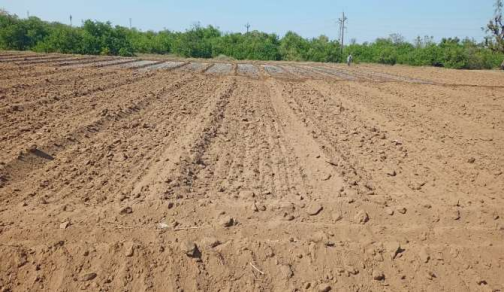
- Wheat : 120 kg/ha, Total 250kg used
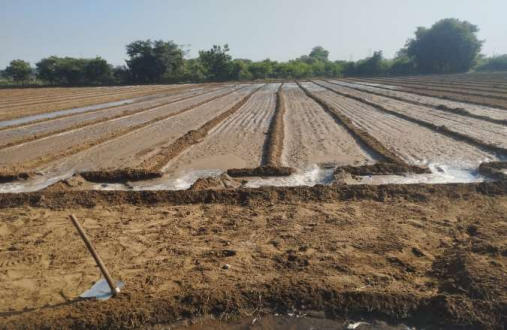
- Mustard: 7 kg/ha
- Fertilizer:
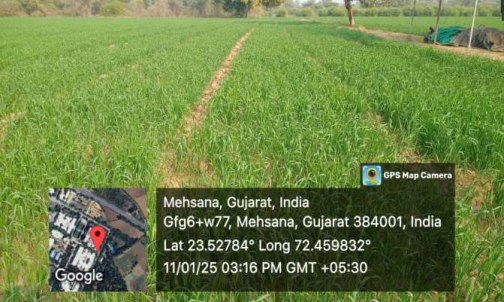
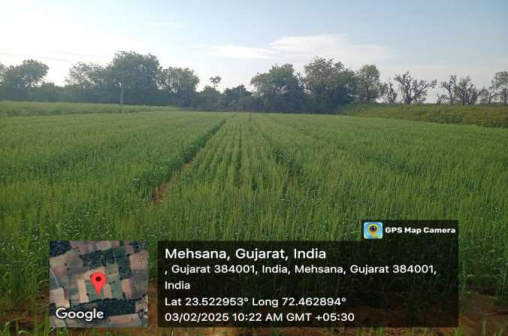
- Wheat crop: 120:100:60, NPK, kg/ha (Urea, DAP and MOP)
- Mustard: 60: 60: 60, NPK, Kg/ha & 19:19:19, NPK (Foliar)
- Weedicide:
- Wheat:
- Pre-emergence (Pendimethaline 30% EC -2 li./ha)
- Post-Emergence (Sulfosulfuron 5% EC- 3 li./ha)
- Mustard :
- Hand Weeding (at 20 DAS)
- Hand Weeding (At 45 DAS)
- Wheat:
| Particulars | Wheat | Mustard |
|---|---|---|
| Season & Year | Rabi-season, 2024-25 | |
| Location | Instructional Farm Agronomy, KKIASR | |
| Experiment duration | November to March 2022-23 (5 Months) | |
| Treatments and fertilizers | As per the recommended | |
| Plot size (a) Gross area | 17600 m2 (Approx.) | 2600 m2 (Approx.) |
| Plot size (b) Net sown | 17000 m2 (1.07 ha) | 8000 m2 (0.8 ha) |
| Spacing | 22.5 cm x 10 cm | 45 x 10 cm |
| Crop and Variety | Wheat, GW-496 | Mustard, GM 6 |
| Seed rate/ha | 120 kg/ha (250 kg used for sowing) | 6-7 kg/ha (10 kg used for sowing) |
| Cultural practices | As per the recommended | |
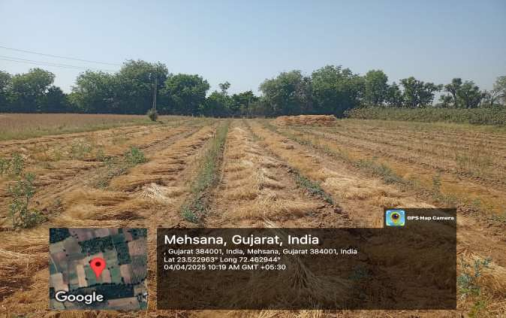
| Harvest | April-2025 | March 2025 |
2. Operations (The cultural operations was carried out)
| Sr. No. | Operations | Wheat | Mustard |
|---|---|---|---|
| 1 | Land preparation | 24/11/2024 | 15/10/2024 |
| 2 | Land levelled | 24/11/2024 | 17/10/2024 |
| 3 | Soil sample collected | 24/11/2024 | 17/10/2024 |
| 4 | Fertilizer application (1st) | 26/11/2024 | 19/10/2024 |
| 5 | Sowing with seed treatment | 26/11/2024 | 19/10/2024 |
| 6 | Irrigation (first) | 27-30/11/2024 | 20/10/2024 |
| 7 | Herbicide application | 01-02/12/2024 | - |
| 8 | Fertilizer application (2nd) | 16/12/2024 | 14/11/2024 |
| 9 | Herbicide application | 24/12/2024 | 21/11/2024 |
| 10 | Fertilizer application (3rd) | 07/01/2025 | 26/12/2024 |
| 11 | Foliar fertilizer application | 27/01/2025 | 11/01/2025 |
| 12 | Fertilizer application | 06/02/2025 | - |
| 13 | Fertilizer application | 20/02/2025 | - |
| 14 | Harvesting | ||
| a. Cutting & Tying | 26-31/03/2025 | 18/03/2025 | |
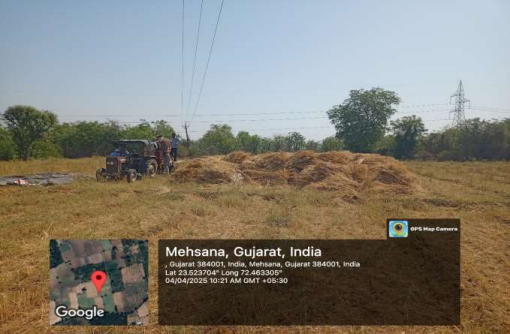
| b. Threshing | 05/04/2025 | 25/03/2025 | |
| c. Cleaning & Packing | 05/04/2025 | 25/03/2025 | |
| Harvesting | |||
| 1 | Crop harvested Grain Yield |
05/04/2025 (6000 kg) |
25/03/25 (500 kg) |
| 1 | Selling (APMC+ Campus) | 220577 | |
5. Expected outcome:
- Learning outcome
- Sustainable wheat farming methods and skills integrated into the curriculum for students, parents and farmers leaning.
- Students, Institute & farmers community is more aware to benefit of the project by dissemination of information and experiences gleaned by the students and farmers.
- Research on low input farming and write fact sheets to explain farming practices in local language that is accessible to farmers and farm advocates.
- Research outcome
- Find out the methods for significantly higher crop production.
- Various agronomical practice will improve yield, Increased farmers income, minimized cost of cultivation, eliminates chemicals, environment conservation & rejuvenates soil health and sustainability.
6. Expertise
- Dr. Naresh Chaudhari (PI) - Assistant Professor (Agronomy), GUNI-KKIASR
- Dr. Jigar Joshi (Co-PI) - Assistant Professor (Agronomy), GUNI-KKIASR
7. Crop Damage assessment (During season)
5-10 % crop was damage by Nilgai/Rabbits/Wild pig during the month of Dec & Jan.
Gallery